SOLUTIONS
Lifecycle Risk Management for Infrastructure
Learn More >>

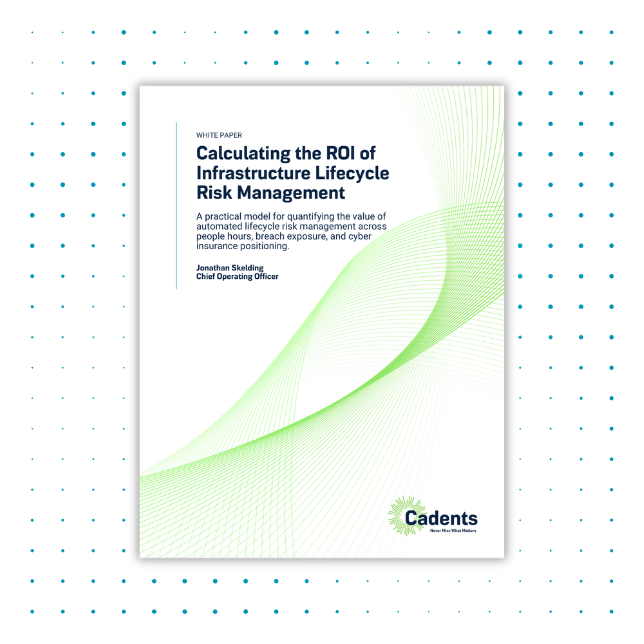
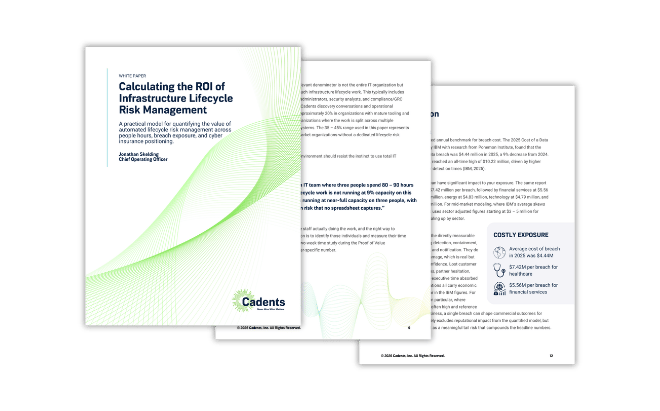
White Paper
Infrastructure lifecycle risk management has shifted from a technical box-checking exercise to a direct input for the office of the CFO. Between a hardening 2026 cyber insurance market and escalating operational labor costs, managing asset lifecycles manually is an expensive gamble.
This authoritative white paper provides a four-driver financial model backed by primary data from the U.S. Bureau of Labor Statistics, IBM, Verizon, and S&P Global Ratings. Learn how a representative mid-market organization can unlock $430,000 in annual quantified value on a modest software investment.

Learn how to transition from manual, reactive risk tracking to a defensible, data-backed model that quantifies your savings across reclaimed IT hours, reduced breach exposure, and optimized cyber insurance premiums.

Why managing disconnected vendor portals, scanner reports, and spreadsheets manually creates operational friction and unquantified tail risk.
Real wage tables calculated against actual U.S. Bureau of Labor Statistics data for Systems Administrators, Security Analysts, and Architects, factored into standard loaded cost formulas.
A breakdown of how to prepare for the 15–20% premium increases forecast by S&P Global Ratings, and how to convert your security posture into verifiable underwriting artifacts.
A step-by-step framework to substitute your own FTE counts, industry breach baselines, and current insurance premiums to generate a localized business case in under 30 days.
Strategic risk management doesn't end with a single white paper. Explore our latest insights and platform overviews to see how Cadents translates infrastructure theory into operational excellence.

Lifecycle Risk Management for Infrastructure
Learn More >>
Your Security Program Has a Blind Spot. Your Insurer Doesn't.

Lifecycle Risk Management: A CFO's Guide to Preventing the Next $10M Breach

The AI Budget Trap: Spending More to Know Less
Grounded in Primary Research. This white paper contains no arbitrary assumptions. Every operational benchmark, salary statistic, and macroeconomic metric is explicitly cited and mapped directly to open-source data from the Ponemon Institute, ServiceNow, Coalition, and industry authorities. Stated Cadents modeled estimates are clearly demarcated and calibrated defensively against real-world customer deployments.